The Van Gogh Museum Theft
Security failures, criminal syndicates, and the race against time to save Van Gogh’s legacy.
By Yusif Babayev
Published: 12 October 2025
The Van Gogh Museum Theft
Security failures, criminal syndicates, and the race against time to save Van Gogh’s legacy.
By Yusif Babayev
Published: 12 October 2025
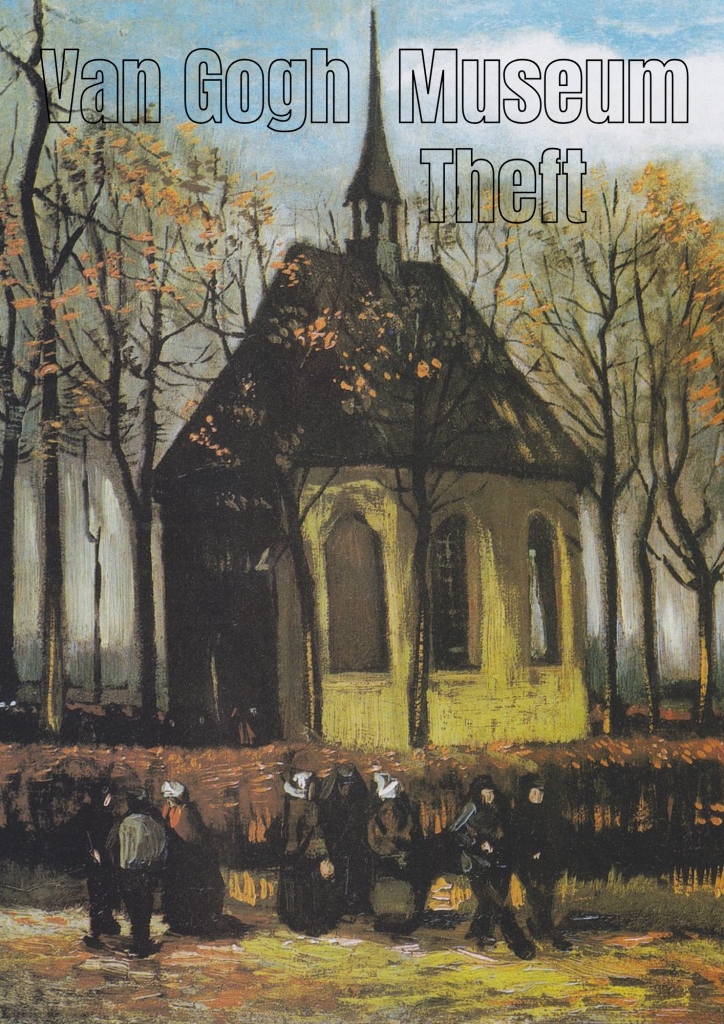
On the quiet, cold night of 7 December 2002, an event shook the art world to its core. In the late hours, the security alarm at the Van Gogh Museum in Amsterdam went off. By the time police arrived, the thieves had already taken what they came for and vanished without a trace. These unknown intruders had stolen two rare Van Gogh paintings – View of the Sea at Scheveningen and Congregation Leaving the Reformed Church in Nuenen – from one of the most famous museums in the world.
The boldness and simplicity of the heist were astonishing. The thieves climbed to the museum’s roof using a ladder, smashed a rear window with a hammer, and slipped inside. The entire operation took less than four minutes. They grabbed the paintings, descended from the building using a rope, and disappeared into the darkness. The theft was so quick and quiet that no one in the vicinity noticed anything suspicious.
When police and museum staff examined the scene, they found a few items – gloves, a rope, a ladder, and a hat. These would later play a crucial role in cracking the case, but at the time, the identity of the thieves remained a complete mystery. There were no witnesses and no surveillance footage. The museum’s outdated security system had made the thieves’ job easier.
Interestingly, this was not the first art heist at the Van Gogh Museum. More than eleven years earlier, in 1991, the museum had faced an even greater threat. That incident went down as the largest art theft in the Netherlands since the Second World War. At that time, the thieves stole 20 paintings, many of them among Van Gogh’s most valuable works.
The 1991 robbery took place in the early hours of 14 April. One of the thieves had hidden inside the museum overnight and let his armed accomplice in; together they took the security guards hostage. They moved quickly through the exhibition hall, removing 20 paintings from the walls and stuffing them into bags before fleeing the scene. Among the stolen works were major masterpieces like The Potato Eaters, Sunflowers, Van Gogh’s Bedroom, and Wheatfield with Crows.
The most unusual part of the 1991 heist was that the paintings were recovered just 35 minutes after the theft. Using clues from the scene, police tracked down the getaway vehicle. The abandoned car was found nearby – with all 20 paintings still inside. However, several of the works had suffered significant damage in the short time they were out of the museum. Some canvases had been torn, and paint layers scratched or cracked due to rough handling and forced removal from their frames.
This event had already exposed the weaknesses in the museum’s security infrastructure. Following the 1991 theft, museum leadership promised to improve its security systems. But the 2002 robbery revealed that either those promises were poorly fulfilled or the upgrades had failed to keep pace with modern criminal tactics. Despite more than a decade between the two heists, both exposed critical vulnerabilities in the museum’s security.
The 1991 robbery also highlighted just how fragile and exposed art collections can be on a global scale. Even though the stolen paintings were recovered quickly, the physical damage and the blow to public trust in the museum lingered for years. Until the 2002 incident, it remained the most serious security crisis in the Van Gogh Museum’s history – and in many ways, it laid the groundwork for what was to come.
The two paintings stolen in 2002 represented distinct periods of Van Gogh’s career. View of the Sea at Scheveningen was one of his earliest surviving works, while Congregation Leaving the Reformed Church in Nuenen depicted the parish where his father served as pastor – a site of deep personal significance for the artist. Both works were exceptionally rare, historically rich, and emotionally charged.
In the days following the theft, Dutch and international media described it as ‘a modern tragedy in the world of art’. Museum officials stated that selling such recognisable works on the black market would be nearly impossible, but acknowledged the possibility that they could have been handed over to mafia networks, private collectors, or used as collateral in narcotics deals. The paintings had vanished and no trace of them would emerge for years.
It was as if the thieves had disappeared underground. The few clues found at the scene were analysed in forensic labs, but yielded no concrete leads. Even with Interpol issuing global alerts, there were no sightings, no suspects, no breakthroughs. The Van Gogh Museum continued to mark the theft’s anniversary each year, appealing to the public for any information and refusing to give up hope.
In December 2003, Dutch police arrested two men suspected of involvement in the case. Court documents and forensic evidence – especially DNA traces found on a glove and a hat left behind – linked them directly to the crime. Eventually, the suspects were identified: Octave Durham, a well-known figure in the Dutch criminal underworld nicknamed ‘The Monkey’, and his associate Henk Bieslijn. Their names would forever be associated with one of the most infamous art thefts in modern history.
Durham later confessed that they hadn’t chosen the paintings for their artistic value but for their small size and ease of transport. Their goal was to sell the works on the black market for a large sum. Shortly after the theft, the paintings were handed over to mafia contacts in Italy. In return, Durham received approximately €350,000, which he used to finance a brief luxury lifestyle, reportedly spending it on fast cars, motorbikes, and holidays.
But even after the arrests, the whereabouts of the paintings remained unknown. The artworks were still considered missing… until a dramatic breakthrough in 2016. That year, Italy’s financial police – the Guardia di Finanza – raided a property linked to mafia boss Raffaele Imperiale in the seaside town of Castellammare di Stabia, near Naples. Inside a concealed wall compartment, officers discovered two carefully wrapped canvases. Expert examination confirmed the unthinkable: they were the missing Van Gogh paintings.
Amazingly, the artworks were in relatively good condition. View of the Sea at Scheveningen had a minor loss of paint in one corner, but even the original grains of beach sand remained intact. That very detail – sand embedded in the brushstrokes – helped confirm the painting’s authenticity. Restoration specialists carried out the necessary conservation work, and in time both pieces were returned to the Van Gogh Museum.
The museum marked the recovery by putting the paintings back on public display, telling the story of the theft and their long journey home. Museum director Axel Rüger called their return one of the ‘most special days in the history’ of the museum, saying the works were ‘home at last’. Visitors lined up in the hundreds to see them.
This story serves as a powerful reminder: art does not only reside on museum walls. Sometimes, it travels through the darkest corridors of the criminal world, hidden and silent – until it is discovered again. Van Gogh’s paintings, too, emerged from the shadows into the light, proving once more that great art can never be truly lost. It only waits to be found.