Discover the Brilliance of the Café Terrace at Night
The story behind the Arles period and the creation of Café Terrace at Night.
By Shams
Published: 12 October 2025
Discover the Brilliance of the Café Terrace at Night
The story behind the Arles period and the creation of Café Terrace at Night.
By Shams
Published: 12 October 2025
The time Vincent van Gogh spent in Arles stands as one of the most defining and creatively rich chapters of his artistic journey. In search of relief from the crowded streets of Paris and the relentless pressure of the art world, he relocated to this quiet town in the south of France in February 1888. Arles, with its peaceful charm, brilliant southern sunlight, and vivid natural palette, became a wellspring of inspiration for the artist. It was here that Van Gogh developed a deeper connection to colour, light, and nature – while also facing some of his most difficult psychological struggles.
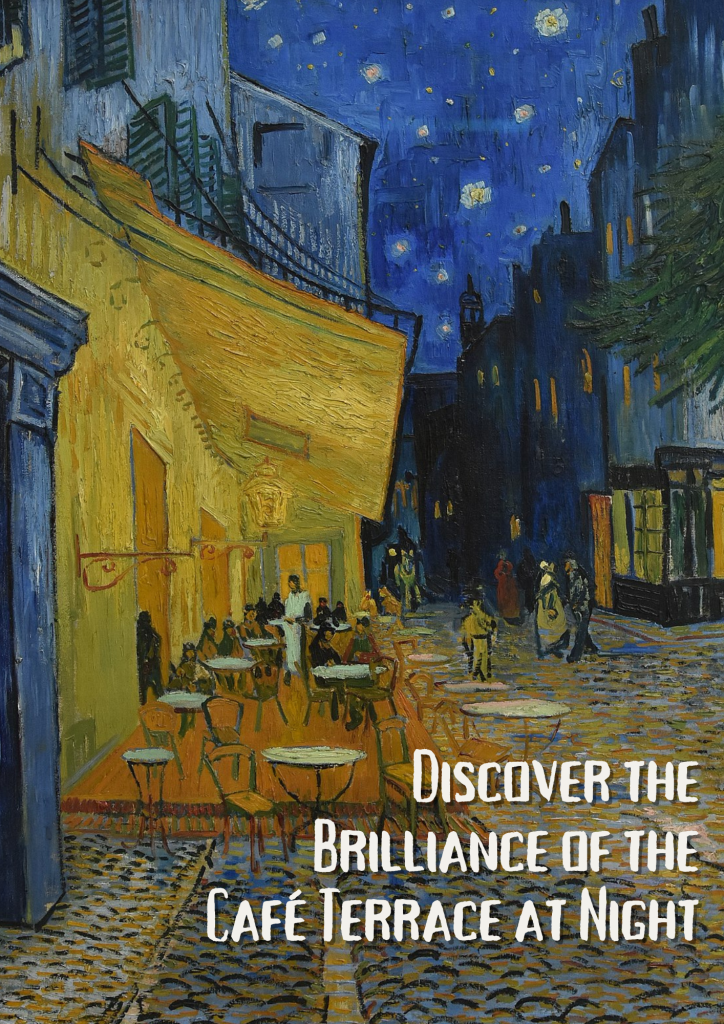
Many of the masterpieces he produced in Arles are among his most celebrated and influential works. In this issue’s Painting section, we take a closer look at Café Terrace at Night – a landmark piece from his Arles period and the first painting in which Van Gogh introduced his now-iconic Post-Impressionist starry night sky.
In the late summer of 1888, Vincent van Gogh stood beneath the skies of Arles, France, and painted one of his most luminous works: Café Terrace at Night. Van Gogh never signed the painting, but because he mentioned the work in his correspondence, art historians are certain that it was painted by him. He created the piece on location rather than from memory.
Before he began to paint, he drew a sketch in ink. The most obvious difference between this sketch and the painting is the absence of stars. Van Gogh did not use black in this painting; instead, he relied on various shades of blue and yellow to convey the scene.
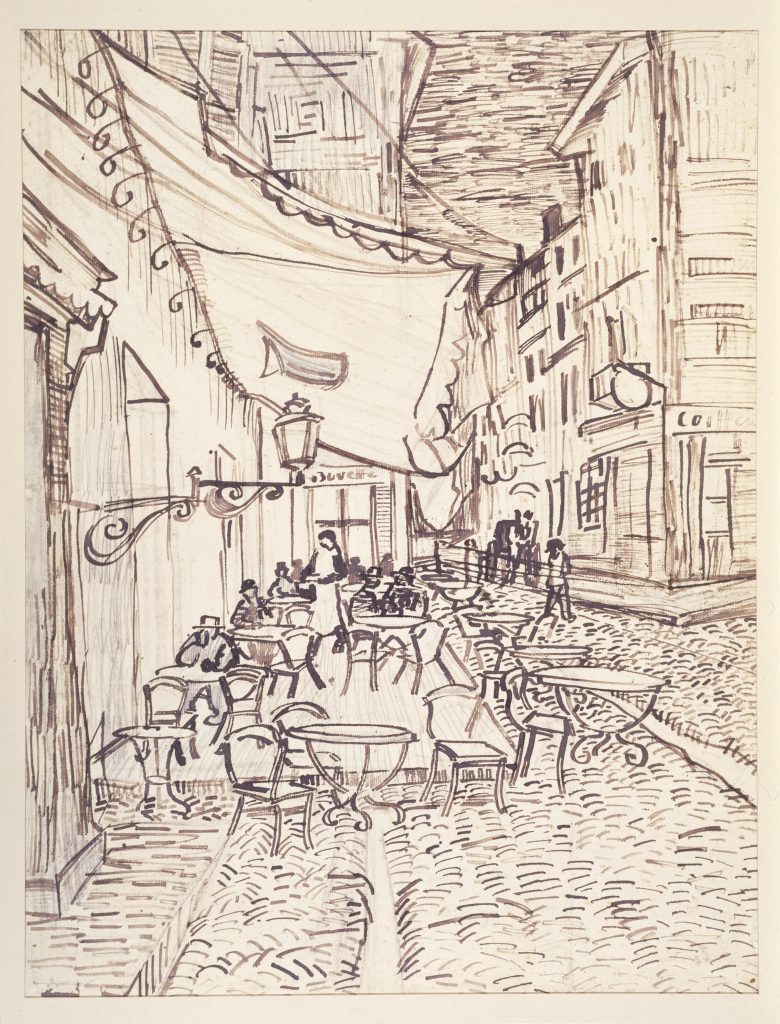
Café Terrace at Night — preparatory study, September 1888. (F1519) Dallas Museum of Art, The Wendy and Emery Reves Collection
‘I often think that the night is more alive and more richly coloured than the day,’ Van Gogh wrote to his sister Willemien. It was this philosophy that drove him to capture the bustling life of a café beneath a deep blue sky without using a single drop of black paint. Indeed, according to astronomical data, the positions of the stars in the painting are historically accurate to the night sky in Arles on 16–17 September 1888.
The scene glows with colour: the vivid yellows of the terrace, the cool cobblestones, and the speckled night sky form a dramatic contrast. The composition guides the viewer’s eye along the terrace and into the background, evoking both depth and intimacy. It was not merely a night scene; it was Van Gogh’s attempt to express profound emotion through colour and light.
Though The Starry Night (1889) would later eclipse it in global fame, Café Terrace at Night marked the first time Van Gogh painted a starry sky, foreshadowing what would become one of his most recognisable motifs. This painting was the beginning of his visual poetry about the night – not as darkness, but as a living, breathing presence full of light and colour.
Today, Café Terrace at Night is housed in the Kröller-Müller Museum in Otterlo, the Netherlands, where it draws admirers from around the world. Meanwhile, the café in Arles still stands and has been transformed into a living tribute to the painting. Now named Café Van Gogh, it has been carefully restored to resemble the glowing terrace that the master immortalised.
Café Terrace at Night remains more than a beautiful image; it marks a turning point – the moment Van Gogh stepped into the night and found a new light.