Á Paris: Where to Go in the City of Mice, Pardon Me, in the City of Lights?
Exploring the Monuments and Museums of the capital of France.
Á Paris: Where to Go in the City of Mice, Pardon Me, in the City of Lights?
Exploring the Monuments and Museums of the capital of France.
By Yusif Babayev
Published: 2 March 2024
By Yusif Babayev
Published: 2 March 2024
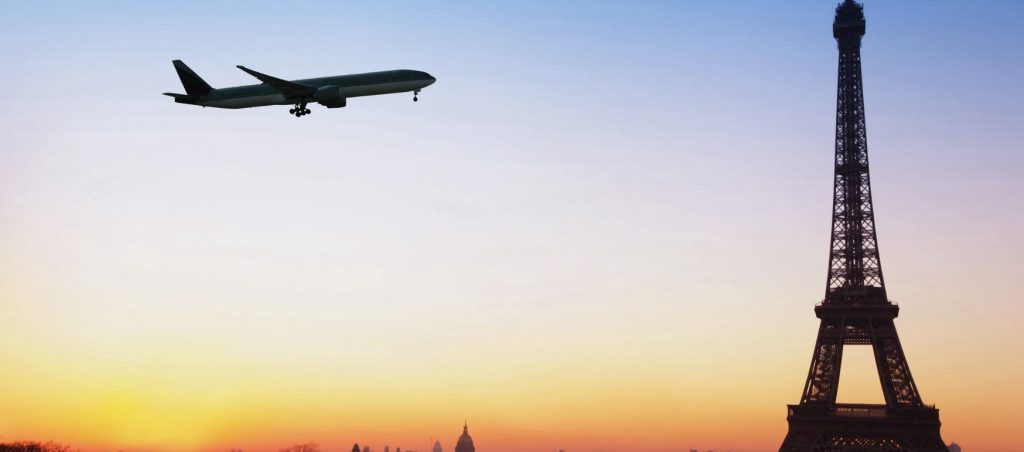
Travel lovers, the day has finally arrived. Please fasten your seatbelts – the aircraft is about to land in one of the most celebrated metropolises in the world. This iconic city welcomes approximately fifty million tourists every year, and on this occasion, you are one of them. Where should you begin your journey in the City of Mice – pardon, the City of Lights? Which monuments deserve a place in your photo album – if you are still creating one? Let us explore the historic architecture and world-class museums of Paris. There is, however, one notable exception on our itinerary: the Palace of Versailles is not situated within Paris proper, but in the town of Versailles, some eighteen kilometres to the south-west.
8. Eiffel Tower
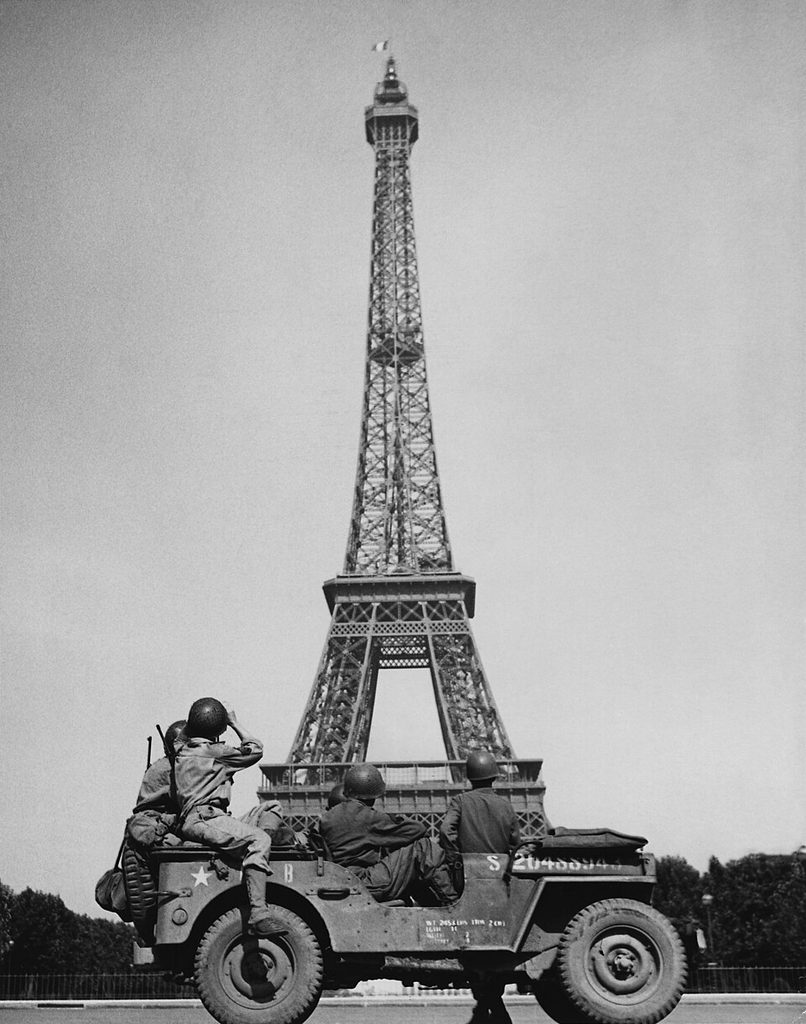
American soldiers watch as the French Tricolour flies once again from the Eiffel Tower, following the Liberation of Paris, 1944.
First, let us begin with a famously underrated structure that few visitors ever seem to notice. Construction of this iconic iron lattice tower commenced 139 years ago, on 28 January 1887. The monument takes its name from the French engineer Gustave Eiffel, whose firm designed and built it, though Eiffel himself modestly referred to it simply as the ‘300-metre tower’. Erected as the grand centrepiece of the 1889 Exposition Universelle, the structure was commissioned to commemorate the centennial of the French Revolution. Standing at a height of 330 metres on the Champ de Mars, the tower dominates the skyline adjacent to the River Seine.
Fun facts:
- A Narrow Escape: The structure came perilously close to destruction during the Second World War, when Adolf Hitler ordered the military governor of Paris, General Dietrich von Choltitz, to demolish the tower alongside the city’s historic monuments before the Allied liberation – an order the general famously disobeyed.
- Civic Amenities: The tower once housed its own working post office on the first floor, as well as a small theatre space.
- Thermal Expansion: The exact height of the monument fluctuates with the seasons. During the height of summer, thermal expansion causes the wrought iron to grow by up to 18 cm, whereas freezing winter temperatures cause the metal structure to contract by as much as 15 cm.
7. Arc de Triomphe
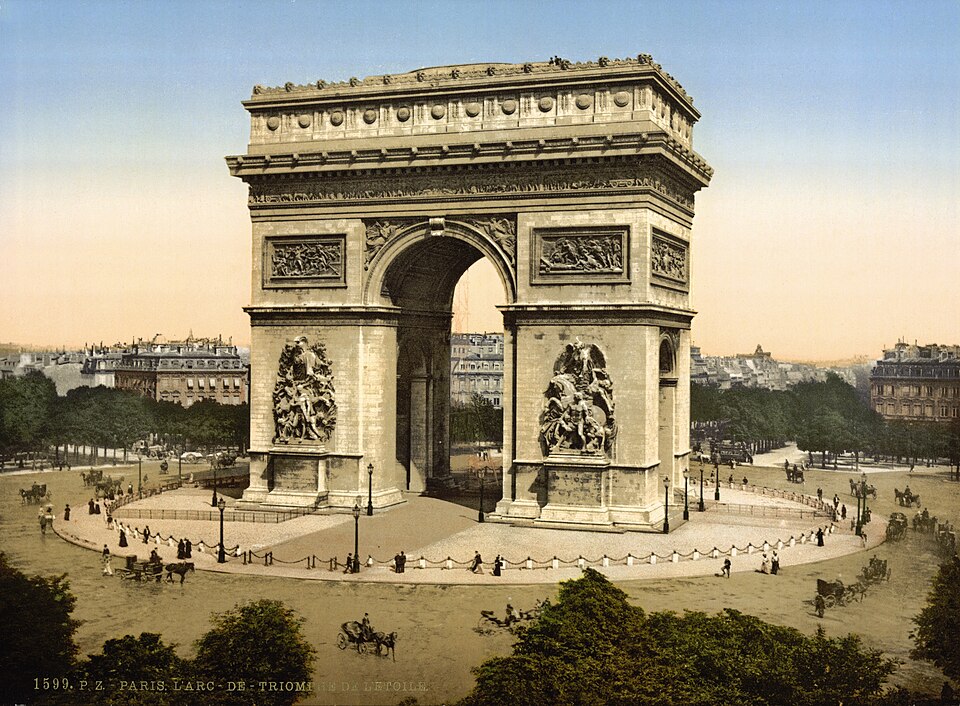
Photochrom print of the Arc de Triomphe de l’Étoile, Paris, c. 1890–1900.
Following his decisive triumph at the Battle of Austerlitz in 1805, Napoleon Bonaparte made a grand promise to the Grand Armée: they would return home beneath triumphal arches. Commissioned by imperial decree, the cornerstone of this monumental Neoclassical arch was laid on 15 August 1806. However, the project was plagued by delays. The principal architect, Jean-François Chalgrin, died in 1811, and with the fall of the First French Empire three years later, construction ground to a halt. It was not until 1832, under King Louis-Philippe, that work officially resumed, with the monument finally completed in 1836 – thirty years after its initial inception.
Napoleon was destined never to walk beneath the completed structure in his lifetime. It was only on 15 December 1840, when his repatriated remains were brought back from the island of Saint Helena, that the Emperor finally passed beneath the Arc de Triomphe on his final journey to the Hôtel des Invalides.
Fun facts:
- Lying in State: Prior to their interments at the Panthéon, the bodies of legendary author Victor Hugo (in 1885) and Allied Supreme Commander Marshal Ferdinand Foch (in 1929) were placed in state beneath the arch, drawing vast mourning crowds.
- Solar Alignment: Twice each year – usually in early May and early August – the setting sun aligns precisely along the axis of the Champs-Élysées, appearing directly within the central archway of the monument when viewed from the east.
- Material & Structure: The monument is constructed from fine-grained Château-Landon limestone, quarried south of Paris, which gives the structure its distinctive ivory tone.
6. Notre-Dame de Paris
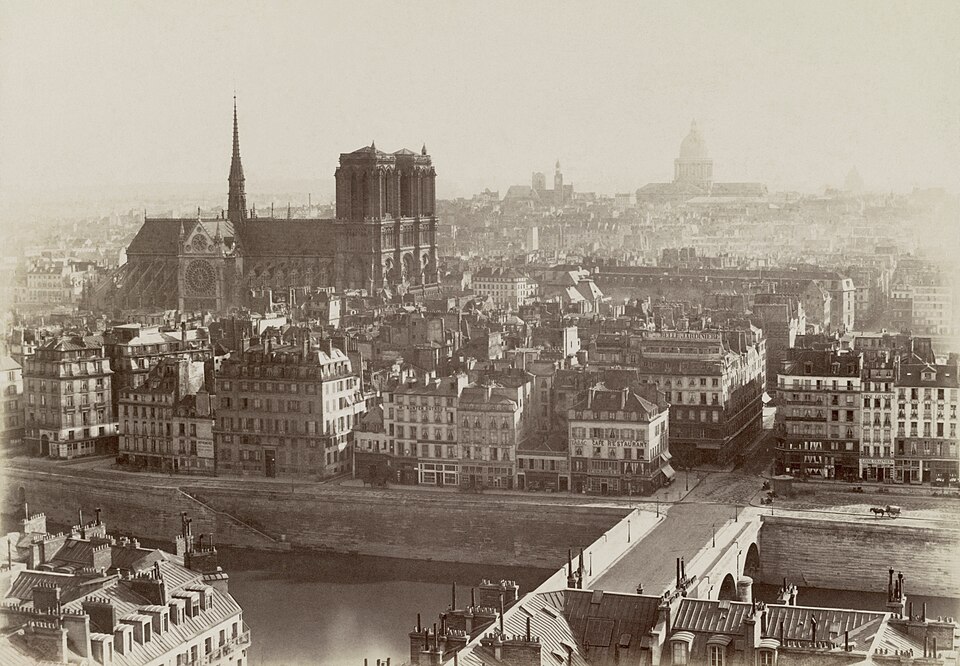
Panorama of Paris with Notre-Dame rising above the Île de la Cité, photograph by Charles Soulier, c. 1865.
One of the most celebrated Gothic cathedrals in the world, Notre-Dame de Paris was constructed between 1163 and 1345. Standing upon the Île de la Cité in the historic heart of the capital, the monument has witnessed centuries of French history – from royal coronations to revolutionary upheaval. Following the catastrophic fire of April 2019, a meticulous five-year restoration project culminated in the cathedral’s triumphant reopening in December 2024, restoring this enduring symbol of France to its full glory.
One of the most famous Gothic cathedrals in the world, Notre-Dame de Paris was built between 1163 and 1345. Standing on the Île de la Cité in the heart of Paris, it has witnessed centuries of French history — from royal ceremonies to revolutions. Although the devastating fire in April 2019 damaged parts of the building, restoration work is ongoing, and Notre-Dame remains a powerful symbol of France.
Fun facts:
- The Great Bell: The cathedral’s famed bourdon bell, Emmanuel, hangs in the south tower. Weighing over thirteen tonnes, it was cast in 1681 and has rung out during key moments in European history ever since.
- The Missing Spire: The nineteenth-century spire destroyed in the 2019 blaze was not part of the medieval structure; it was added during the cathedral’s famous mid-nineteenth-century restoration by architect Eugène Viollet-le-Duc.
- The Grand Organ: Boasting more than 8,000 pipes, the cathedral’s monumental organ dates from the eighteenth century. Miraculously surviving the heat and smoke of the 2019 fire, it was meticulously cleaned, reassembled, and tuned ahead of the cathedral’s reopening.
Editor’s Note: Notre-Dame de Paris formed the central feature of our third issue. Whilst physical back issues are currently out of stock, a special anthology re-release of our inaugural three issues is currently in preparation, which will allow readers to revisit the complete architectural feature in print.
5. The Louvre Museum
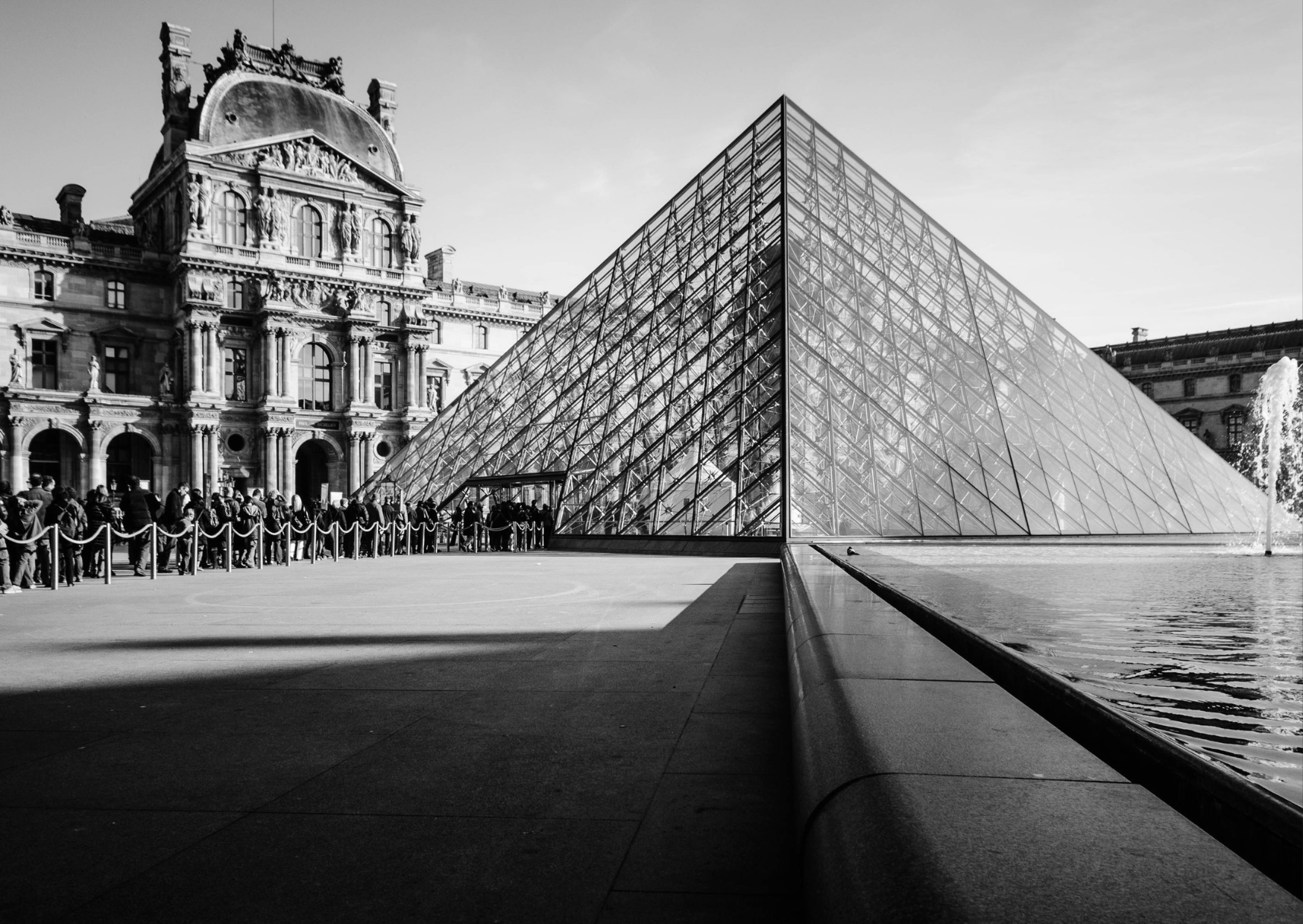
The Louvre Pyramid and the historic Louvre Palace, Paris.
The Louvre is the largest art museum in the world, occupying a vast palace complex whose origins trace back to the late twelfth century. Originally commissioned as a medieval fortress under King Philippe II to defend Paris from western attack, the structure was transformed in 1546 by Francis I into a grand royal residence built in the French Renaissance style. When Louis XIV elected to move the French court to Versailles in 1682, the Louvre was repurposed as a residence and studio space for artists under royal patronage.
The crown’s expanding art collections – enriched by the personal acquisitions of Francis I and Louis XIV, as well as the purchase of over 100 masterpieces from banker Everhard Jabach – formed the foundation of the museum’s holdings. During the French Revolution, the palace was converted into a national institution. In 1791, the National Constituent Assembly decreed that the Louvre should serve as ‘a place for bringing together monuments of all sciences and arts’. The museum officially opened its doors to the public on 10 August 1793, exhibiting an initial collection of 537 paintings and 184 decorative objects.
Fun facts:
- Staggering Valuation: The total combined value of the Louvre’s architectural structure, historic galleries, and unmatched artistic holdings is conservatively estimated at well over £35 billion ($45.5 billion).
- Domestic Heritage: Approximately two-thirds of the museum’s vast collection of painted works were executed by French masters.
- Scale & Endurance: With over 35,000 works of art on public display across 73,000 square metres, spending just thirty seconds observing every individual item would require roughly 100 consecutive days of continuous viewing.
4. Musée d’Orsay
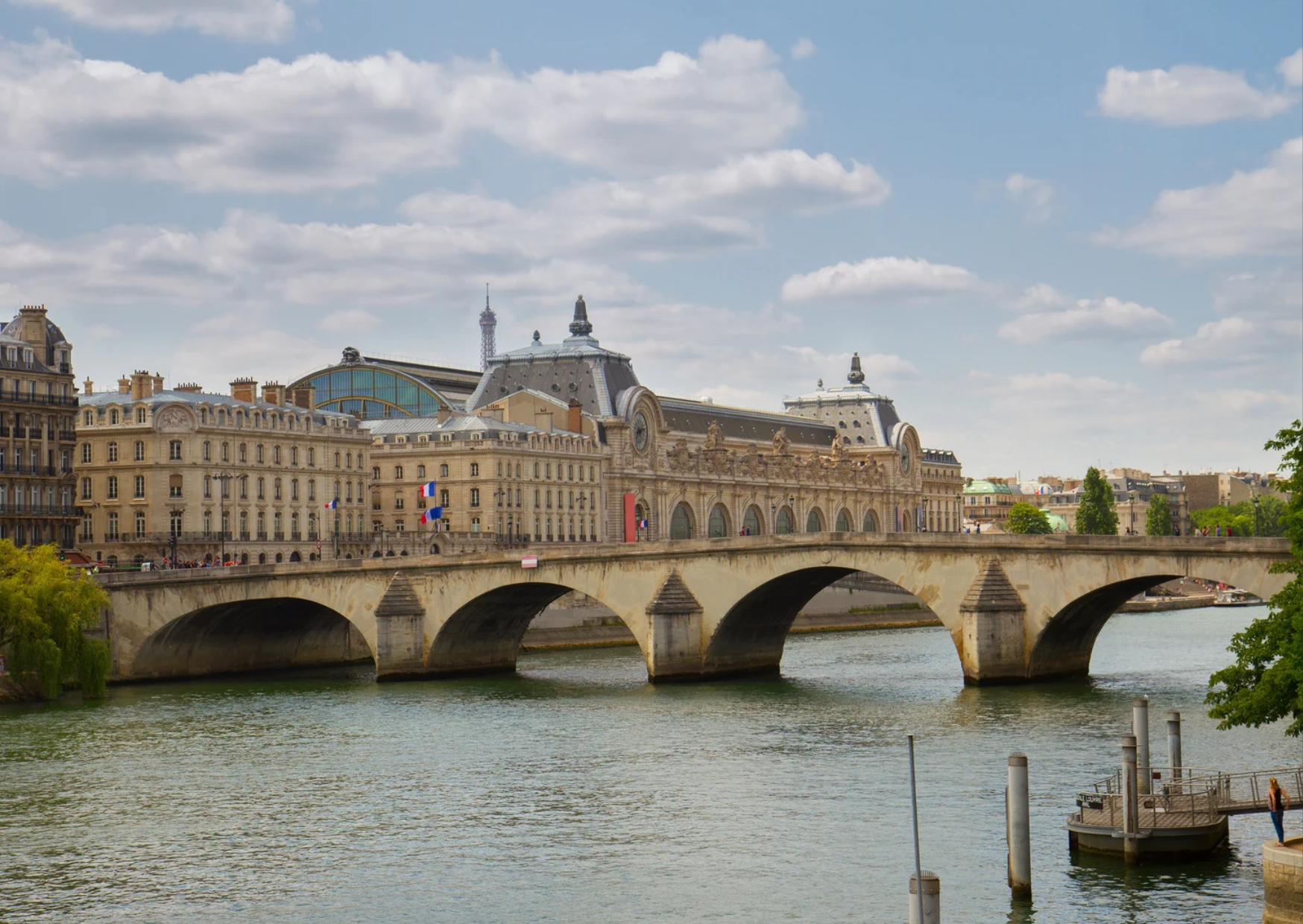
The Musée d’Orsay and the Seine, with the Eiffel Tower visible in the background, Paris.
Housed within the monumental Beaux-Arts frame of the former Gare d’Orsay railway station – constructed between 1898 and 1900 for the Exposition Universelle – the Musée d’Orsay stands as one of Paris’s most breathtaking cultural spaces. The initiative to convert the decaying station into a museum originated in the 1970s under the Directorate of the Museums of France. Reconstruction work proceeded between 1983 and 1986 under the direction of French architects Renaud Bardon, Pierre Colboc, and Jean-Paul Philippon, whilst Italian architect and designer Gae Aulenti was commissioned to design the museum’s celebrated interior layout. Officially inaugurated on 1 December 1986 by French President François Mitterrand, the institution houses the world’s premier collection of Impressionist and post-Impressionist masterpieces.
Fun facts:
- Station Architecture: The conversion carefully preserved the hall’s original industrial architecture, including its vaulted glass roof. The magnificent station clock overlooking the Seine has remained in continuous operation since the building opened in 1900.
- Heavy Metal: Construction of the original station required 12,000 tonnes of structural metal – significantly more than the 7,300 tonnes utilized for the Eiffel Tower. Remarkably, the entire terminal was erected in just two years under the supervision of architects Victor Laloux, Lucien Magne, and Émile Bénard.
3. Sainte-Chapelle
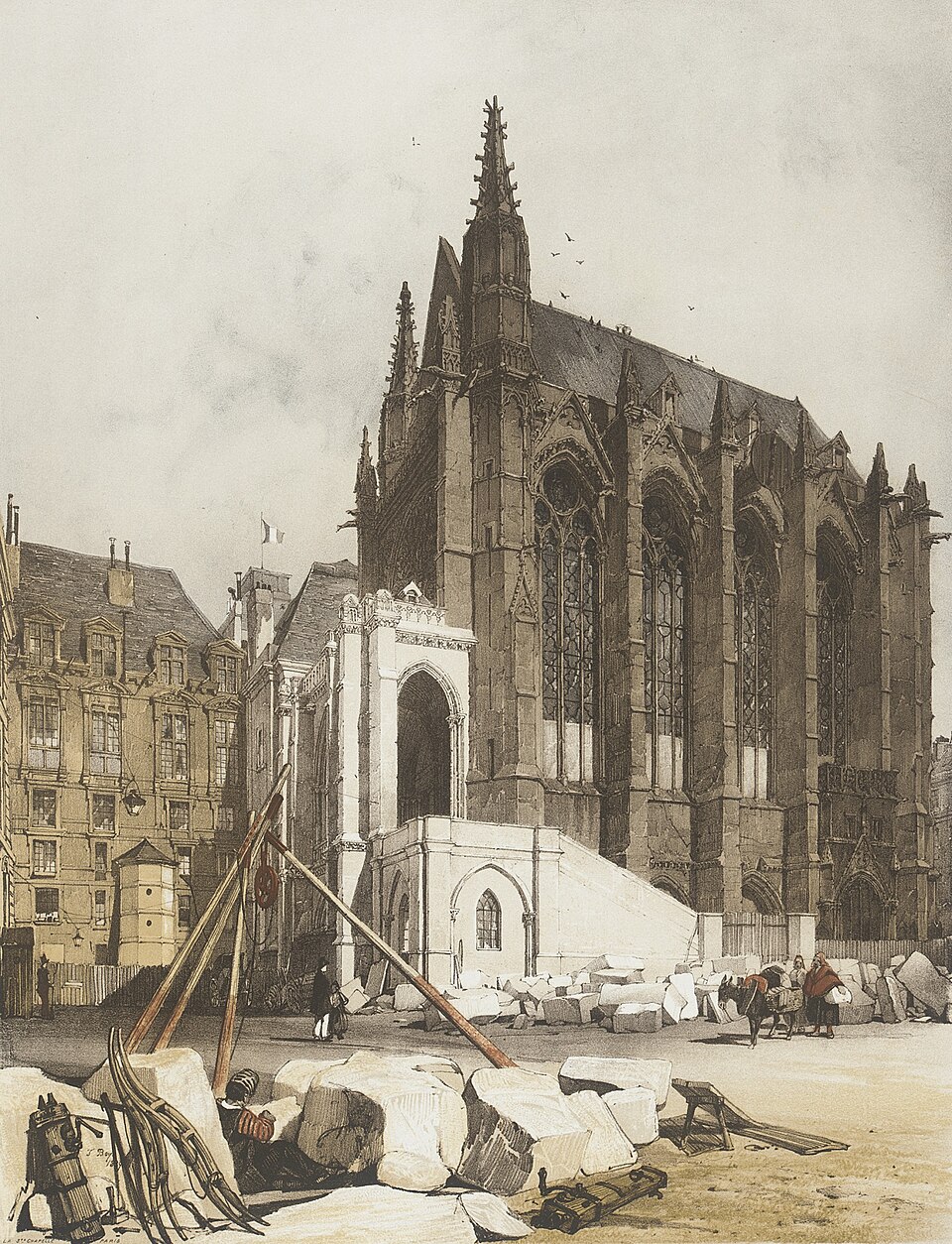
La Sainte-Chapelle, Paris, on the eve of its restoration, print by Thomas Shotter Boys.
A masterpiece of Rayonnant Gothic architecture, Sainte-Chapelle was constructed in the mid-thirteenth century under the direction of King Louis IX (Saint Louis). Consecrated in 1248, the royal chapel was commissioned specifically to house Louis IX’s extraordinary collection of Passion Relics. Principal among these treasures was the Crown of Thorns – one of the most sacred relics in medieval Christendom – which was later preserved in nearby Notre-Dame Cathedral, where it miraculously survived the devastating fire of 2019.
Fun Facts:
- Sacred Holdings: The chapel originally housed twenty-two distinct holy relics acquired by Louis IX, though many were lost or dispersed during the centuries that followed.
- Resilience: Over its eight-century existence, the delicate structure survived two major fires and a catastrophic flood, as well as severe damage and desecration during the French Revolution, when its spire was demolished and the interior repurposed as a flour store.
- Interactive Deciphering: The chapel’s world-famous stained-glass windows depict over 1,100 biblical scenes across fifteen towering panels. Visitors can decode the complex iconography using the official downloadable ‘Sainte-Chapelle Windows’ application.
2. Palace of Versailles
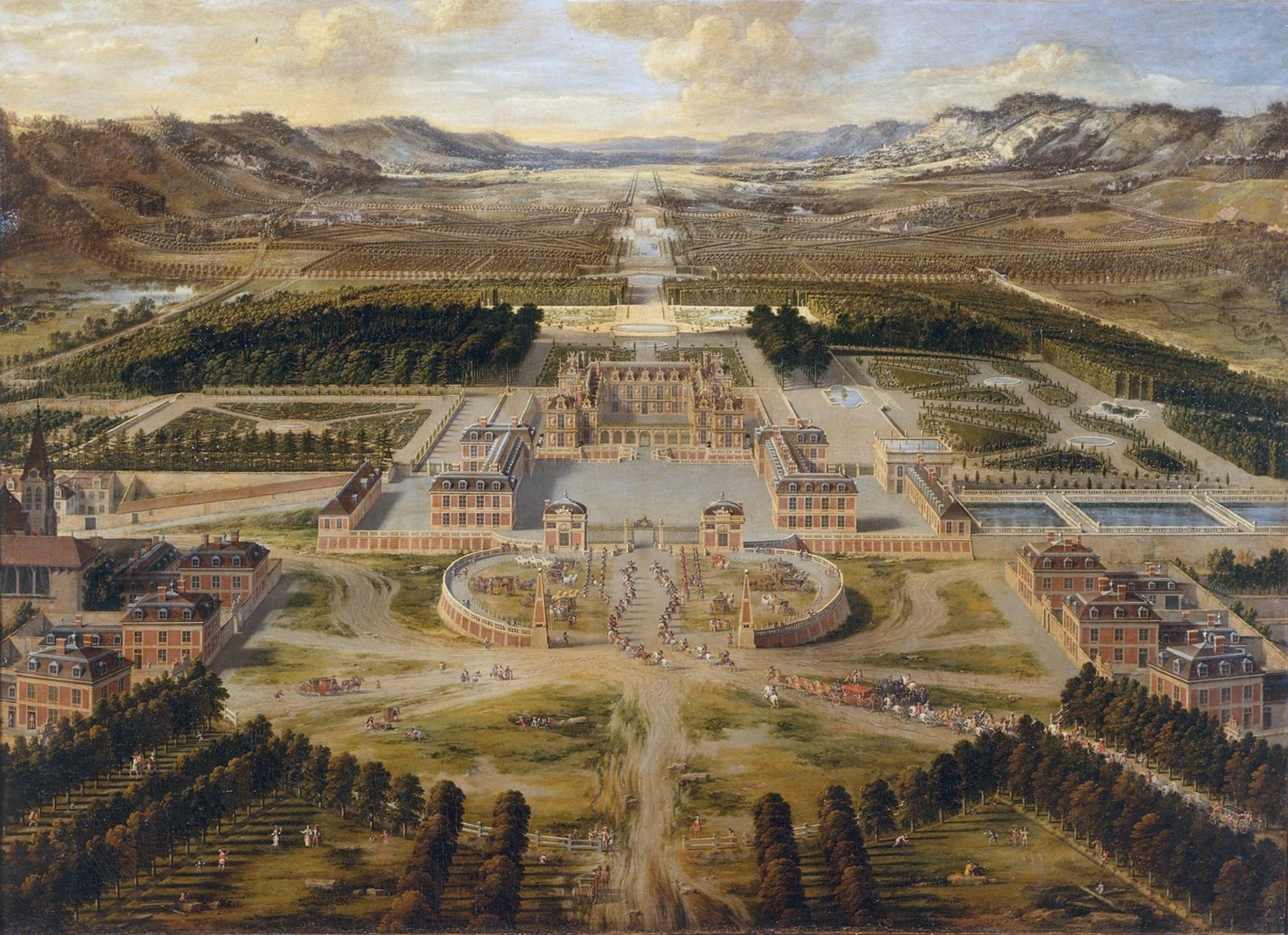
View of the Château de Versailles in 1668, painting by Pierre Patel.
The construction of the grand Palace of Versailles, built in the Classical and French Baroque architectural styles, began 365 years ago in 1661. Three key figures played an instrumental role in bringing Versailles to life: the French architect Louis Le Vau, the French landscape architect André Le Nôtre, and the French painter Charles Le Brun. Louis Le Vau served as chief architect for the monumental expansion, André Le Nôtre was responsible for the design of the formal gardens and surrounding grounds, and Charles Le Brun acted as principal decorator and painter, overseeing the artwork and overall interior aesthetics of the palace halls. Today, approximately 15,000,000 visitors travel to explore the palace, parkland, and sprawling gardens of Versailles every year.
Fun facts:
- The Hidden Library: The palace contained a discreetly concealed private library within the royal quarters, housing a collection of over 4,000 meticulously bound volumes away from the scrutiny of court life.
- The Ghost of the Queen’s House: The Queen’s House, a secluded retreat situated within the idyllic Queen’s Hamlet in the estate’s gardens, became famous for long-standing rumours alleging it was haunted by the phantom of Marie Antoinette.
- Cold Royal Feasts: The sheer scale of the palace meant that the central kitchens were located a vast distance from the king’s private dining chambers; as a result, Louis XIV’s multi-course meals were frequently served lukewarm or cold by the time they arrived at his table.
1. Musée Rodin
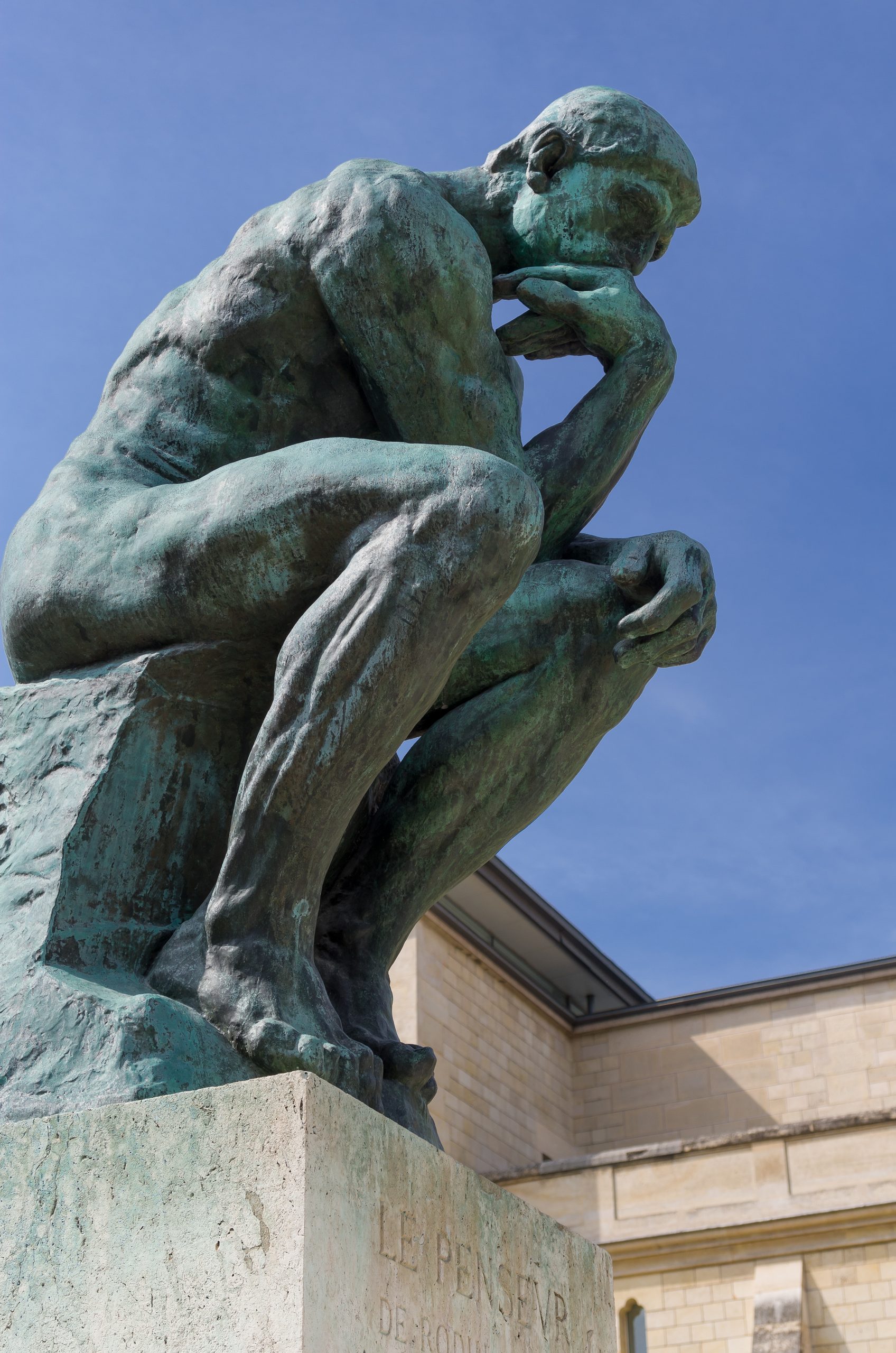
The Thinker (1904) in the garden of the museum. | Photo by Douglas O’Brien licensed under CC BY-SA 2.0
Not to be confused with its Philadelphia namesake, this feature concerns the primary Musée Rodin in Paris. Inaugurated in 1919, the museum is devoted primarily to the life and oeuvre of the celebrated French sculptor Auguste Rodin. Housed within the historic Hôtel Biron and its surrounding sculpture gardens, the institution’s vast permanent holdings comprise 6,600 sculptures, 8,000 drawings, 8,000 archival photographs, and 7,000 decorative artworks (objets d’art).
Fun facts:
- A Religious Calling: Prior to establishing his artistic career, Auguste Rodin explored several vocational paths, even joining the Congregation of the Blessed Sacrament as a novice priest in 1862 following the traumatic death of his sister Maria.
- Late Wedlock: Rodin married his lifelong companion and primary model, Rose Beuret, in January 1917 – fifty-three years after they first met, and mere weeks before her death, with Rodin passing away later that same year.
- Global Castings: Rodin’s iconic masterwork, The Thinker (Le Penseur), was cast in multiple authorised bronze editions, which are now displayed in museums and public spaces across the world.