The Roussos Phenomenon
From Aphrodite’s Child to his solo career — everything about Demis Roussos.
The Roussos Phenomenon
From Aphrodite’s Child to his solo career — everything about Demis Roussos.
By Yusif Babayev
Published: 27 September 2024
By Yusif Babayev
Published: 27 September 2024
On 14 June 1985, everything appeared to be in order at Ellinikon International Airport in Athens. TWA Flight 847, arriving from Cairo, had landed safely, and preparations were underway for its onward journey to Leonardo da Vinci International Airport in Rome. Passengers took their seats, and the aircraft departed in the morning. Shortly after take-off, however, the plane was hijacked.
There were 147 people on board, including the famed Greek singer Demis Roussos, who was due to celebrate his birthday the following day. On the second day of the ordeal, the Greek government agreed to release Ali Atwa, an alleged accomplice of the hijackers. In return, the hijackers released Roussos and four other Greek passengers in Beirut. They were subsequently flown back to Athens on a charter flight, where hundreds of family members, journalists, and devoted fans gathered at the airport to greet them. The incident created a sensation worldwide. In a brief statement to reporters, Roussos described the hijacking as a deeply tense and traumatic experience, whilst expressing his heartfelt hope that the remaining hostages would return home safely.
To understand the trajectory of his extraordinary life, one must rewind to the very beginning. Demis Roussos was born on 15 June 1946 in Alexandria, Egypt. His father, George Roussos, was an engineer and accomplished classical guitarist, whilst his mother, Olga, performed alongside her husband in a local Greek amateur theatre company. From an early age, Roussos studied music and joined the Byzantine choir of the Greek Church in Alexandria. His formative musical palette was shaped by a blend of jazz, traditional Arabic melodies, and Greek Orthodox liturgical chants. However, following the loss of their property during the 1956 Suez Crisis, the family was forced to leave Egypt and emigrate to Greece.
At the age of seventeen, Roussos joined The Idols, a youth band formed in Athens during the early 1960s to give emerging musicians practical experience. Roussos served as lead vocalist, performing alongside keyboardist Evángelos Papathanassíou (later world-famous simply as Vangelis) and drummer Loukas Sideras. The Idols left behind no official studio albums or widely recognised original recordings. Roussos subsequently joined another modest local cover band, the Athens-based group We Five, again taking on lead vocal duties.
In 1967, the three former bandmates from The Idols reunited to form a new group dedicated to pop, psychedelic, and progressive rock. Vangelis Papathanassiou served as the principal composer and keyboardist, Loukas Sideras provided drums and rhythm, and Roussos took centre stage as lead vocalist. They were joined by guitarist Silver Koulouris, a well-regarded figure within the local Greek music scene whom Vangelis and Sideras knew from recording studios and local clubs.
The quartet’s earliest recording session was for George Romanos’s album In Concert and in Studio, where they performed on four tracks and were credited as ‘Vangelis and his Orchestra’. That same year, the band recorded a two-song demo and submitted it to Philips Records.
The geopolitical landscape soon disrupted their plans. Following the rise of a right-wing military dictatorship in Greece in 1967, the musicians decided to relocate to London, which promised a more receptive creative environment. The move faltered almost immediately: Koulouris was unable to leave Greece due to his mandatory military service, whilst the remaining three members were stranded in Paris en route to the UK due to visa issues and the widespread strikes of May 1968.
While stuck in Paris, the band signed a recording contract with Mercury Records, where American producer and manager Lou Reizner christened the unnamed group Aphrodite’s Child. The band soon released their second single, ‘Rain and Tears’. Composed by Vangelis with lyrics by Richard Francis, the track became an overnight sensation across France and continental Europe, driven by Roussos’s soaring, operatic vocal delivery.
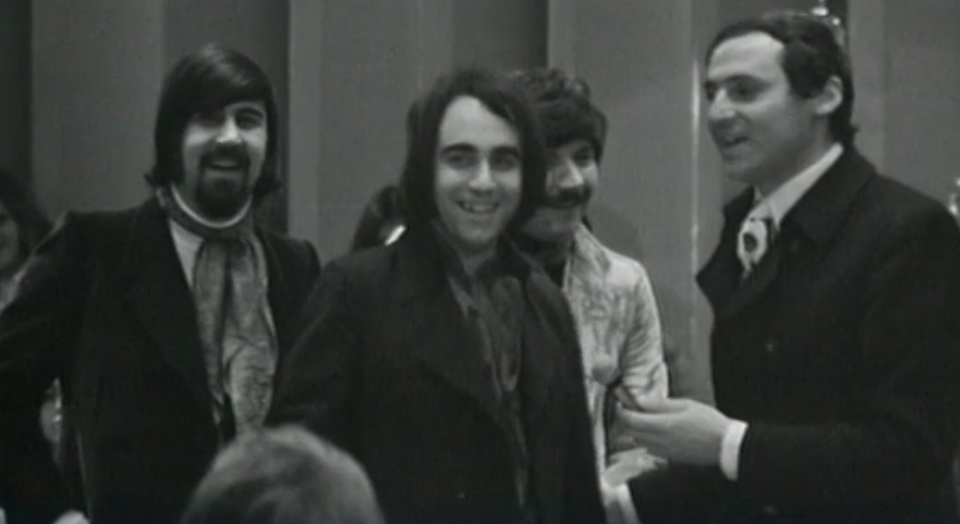
Members of Aphrodite’s Child appearing on the Italian TV programme ‘Speciale per voi’, 1969. | Photo by Carla Ragionieri
Despite being sung in English, ‘Rain and Tears’ topped charts throughout Europe, selling over one million copies and earning a Gold Disc. In October 1968, the band released their debut studio album, End of the World.
To record their follow-up, the band travelled to Trident Studios in London. The album’s lead single, ‘Let Me Love, Let Me Live’, was released in November 1969, preceding the full-length record It’s Five O’Clock in January 1970. The album featured a rich collection of ballads – including the popular title track – alongside excursions into genres such as country rock.
Despite their growing commercial triumph, touring exposed deep artistic fractures. Vangelis increasingly declined to tour, preferring to remain in Paris to compose the film score for Henry Chapier’s Sex Power. For live appearances and television broadcasts, his brother, Nikos Papathanassiou, initially stepped in on keyboards, followed by Harris Halkitis during tours of Spain and Italy.
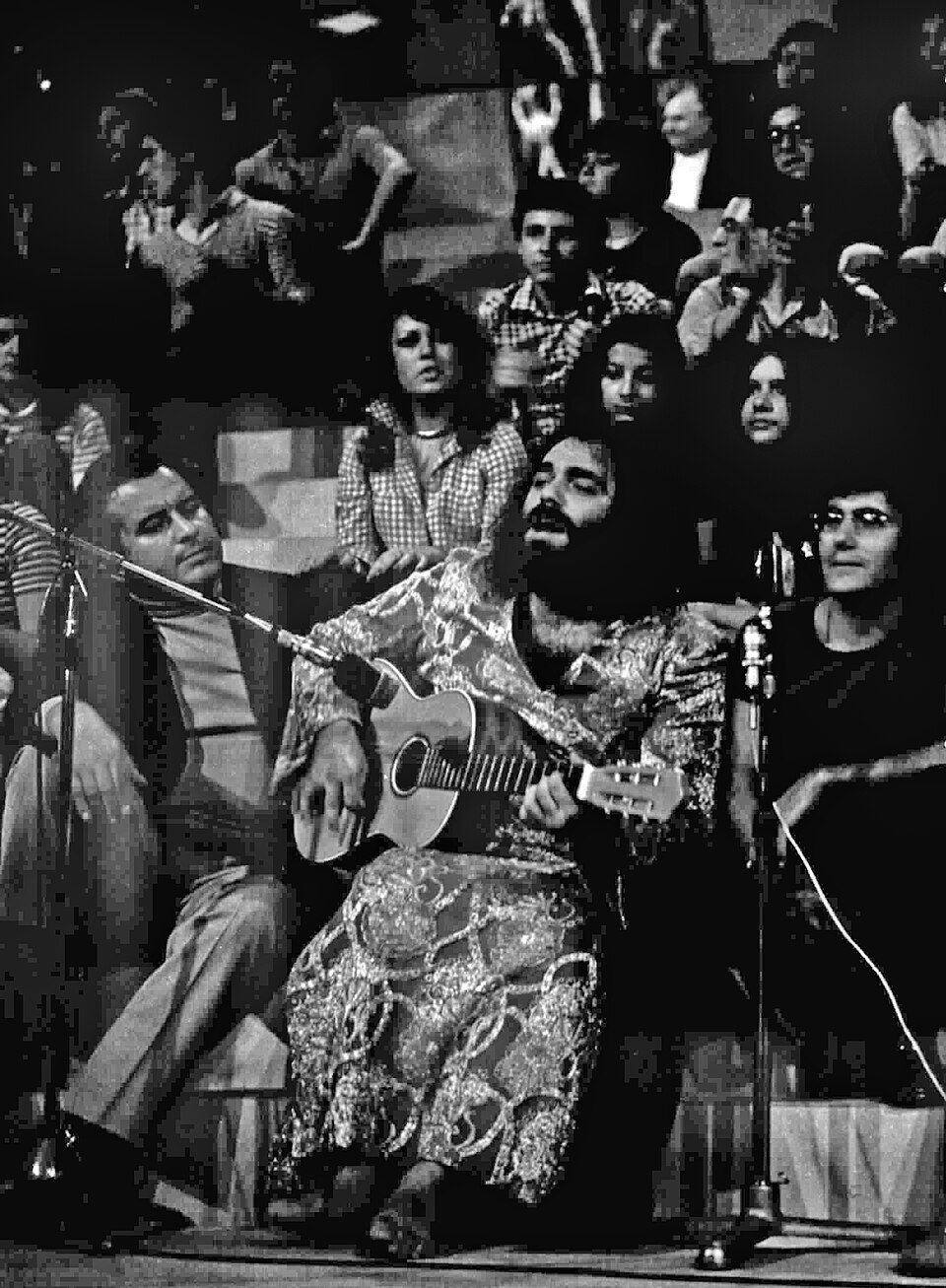
Demis Roussos performing on the Italian television show ‘Tutto è pop’, Turin, 1972.
In late 1970, the band embarked on their most ambitious project yet: a musical adaptation of the Biblical Book of Revelation, titled 666. Silver Koulouris, having completed his compulsory Greek military service, rejoined his bandmates in the studio. However, personal relationships within the group had begun to sour, a rift exacerbated by the arduous and painstaking creative process. The music composed by Vangelis leaned heavily towards avant-garde, psychedelic, and progressive rock – a sharp departure that alienated the other members, who preferred to remain within the lucrative realm of melodic pop and soft rock.
By the time 666 was finally released in June 1972, Aphrodite’s Child had already disbanded. Though the double album would later be celebrated as their crowning artistic achievement, mounting creative friction ultimately sealed their dissolution.
Following the split, the three friends pursued individual paths. Loukas Sideras experienced modest success as a solo artist, releasing two albums and four singles in the aftermath of the band’s demise. Koulouris worked intermittently with Roussos and occasionally with Vangelis, whilst Vangelis and Roussos would go on to forge several memorable creative partnerships later in their respective solo careers.
Demis Roussos’s solo trajectory began in earnest in 1971 with the release of his debut single, ‘We Shall Dance’ – featuring Sideras on drums – followed by his first studio album, On the Greek Side of My Mind. Both the single and the album achieved widespread commercial success across continental Europe, charting prominently in the Netherlands, Belgium, Greece, and Germany. Blending infectious pop melodies with rich Mediterranean folk instrumentation, the record accentuated Roussos’s magnificent, evocative tenor, firmly establishing his international reputation as a charismatic solo performer.
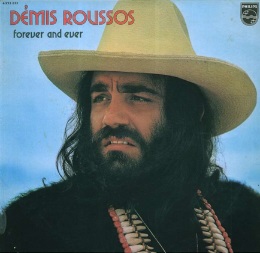
Album cover for ‘Forever and Ever’ by Demis Roussos.
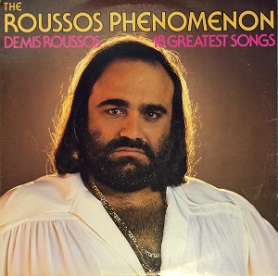
Album cover for ‘The Roussos Phenomenon’ by Demis Roussos.
In 1973, Demis Roussos achieved widespread international stardom with his single ‘Forever and Ever’ and the hit album of the same name. The record topped charts across continental Europe, whilst his lush melodic ballads – most notably ‘My Friend the Wind’ – captivated millions of listeners.
Throughout the first half of the 1970s, Roussos was a towering pop icon across mainland Europe and the Soviet Union, yet he remained virtually unknown across the English Channel. For some reason, his fame had crossed continents but failed to reach the British Isles. This anomaly caught the attention of BBC television producer John King, who produced a 1976 documentary titled The Roussos Phenomenon. The broadcast ignited immense curiosity among British audiences, prompting Philips Records to issue a four-track extended play (EP) of the same title, featuring ‘Forever and Ever’, ‘Sing an Ode to Love’, ‘So Dreamy’, and ‘My Friend the Wind’. The release created history by becoming the first EP ever to reach number one on the UK Singles Chart, finally delivering Roussos his long-overdue breakthrough in Britain.
Whilst Roussos commanded a vast following in the West, his cultural footprint within the Soviet Union was exceptional. Tracks such as ‘Goodbye My Love, Goodbye’ and ‘Far Away’ were deeply cherished by Soviet audiences. However, one composition in particular achieved legendary status in the USSR despite making only a modest impression on European charts: ‘From Souvenirs to Souvenirs’. Written by Alec R. Costandinos and Stélios Vlavianós, the melancholic ballad resonated with Soviet listeners on an unprecedented level, becoming the definitive anthem associated with Roussos across the region.
A Greek version of the track, performed by Marinella, was released the same year but failed to match Roussos’s impact, whilst Roussos himself recorded a German rendition entitled ‘Mein Leben ist ein Souvenir’. Yet none rivalled the enduring affection held for the original English recording throughout the former Eastern Bloc.
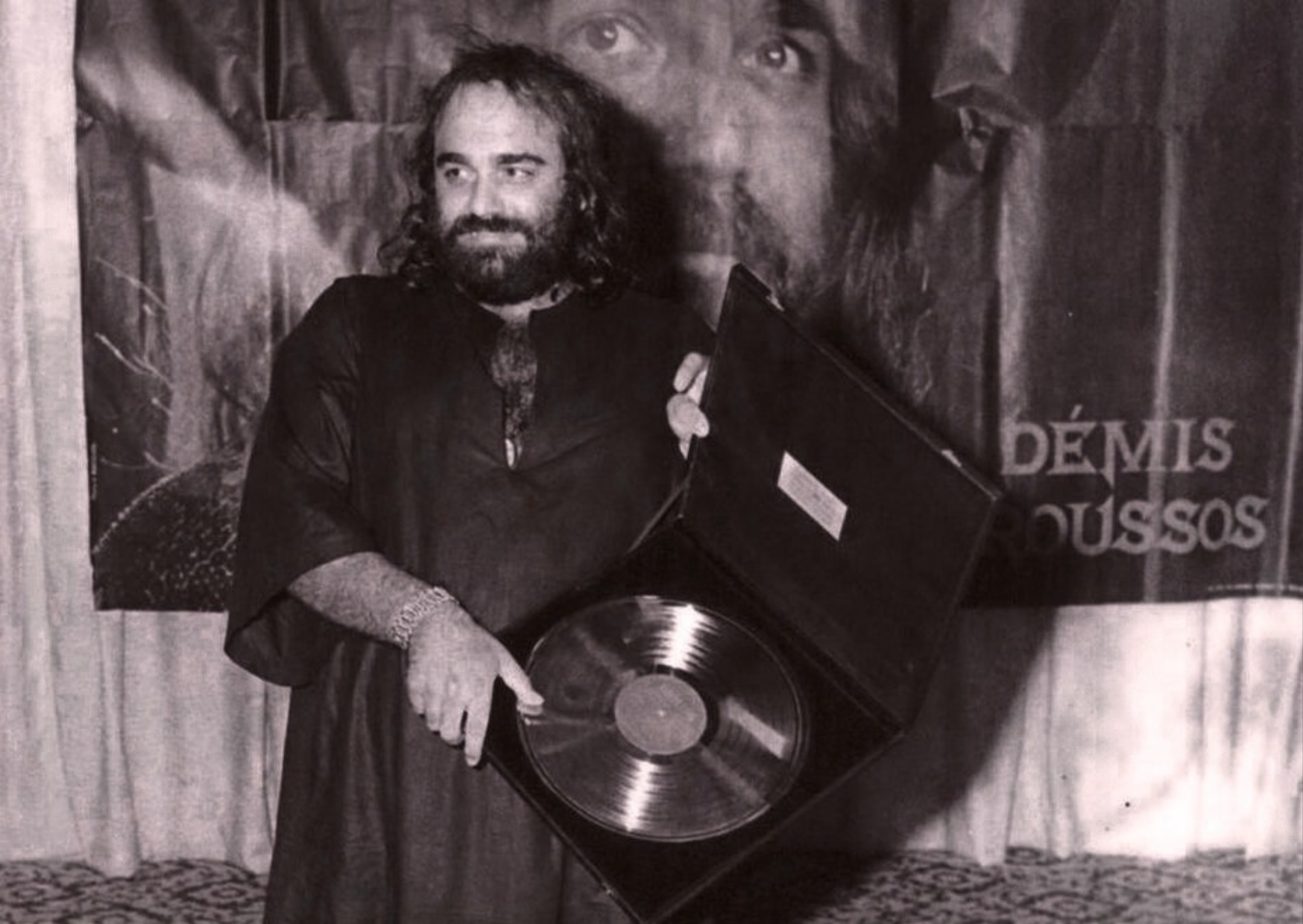
Demis Roussos posing with a gold record at a press event.
The song also spawned several Russian-language adaptations. Just a year after its original release, Demis Roussos’s signature ballad was reimagined by Zhanna Bichevskaya as ‘Risuyut Malchiki Voynu’ (‘Boys Draw War’), featuring poignant lyrics written by Andrey Bogoslovsky. In 1977, the Soviet ensemble Krasniye Maki released another cover titled ‘First Love’, which achieved enormous popularity across Russia. It rapidly became a mainstay for young acoustic guitarists and a ubiquitous staple of dance halls throughout the country.
When Roussos toured the Soviet Union for the first time during the 1990s, he initially omitted the track from his setlist, unaware of its profound cultural resonance and assuming it was merely a minor entry in his catalogue. Upon learning of the omission, music journalist and radio presenter Boris Barabanov intervened, cautioning the singer that leaving the stage without performing ‘From Souvenirs to Souvenirs’ would spark outrage among the crowd. Roussos duly obliged, delivering a triumphant live performance that solidified his legend in the region.
Just as the 1976 documentary The Roussos Phenomenon successfully introduced his extraordinary talent to British audiences, the purpose of this article – bearing the same title – is to reintroduce younger generations to a titan of 20th-century popular music. In an era often dominated by fleeting, disposable hits, celebrating Roussos is an invitation to rediscover vocal majesty and timeless craftsmanship. Perhaps, in our own small way, this tribute will succeed in keeping that phenomenon alive.